NeuroScope 3D
Brain Tumor Segmentation · team project with Yash Jain
My contribution
This was a team project with Yash Jain, who is credited in the repository's source headers. My part was the training runs, the HPC orchestration and the evaluation, and I do not claim authorship of the codebase. The figures here come from the evaluation I ran.
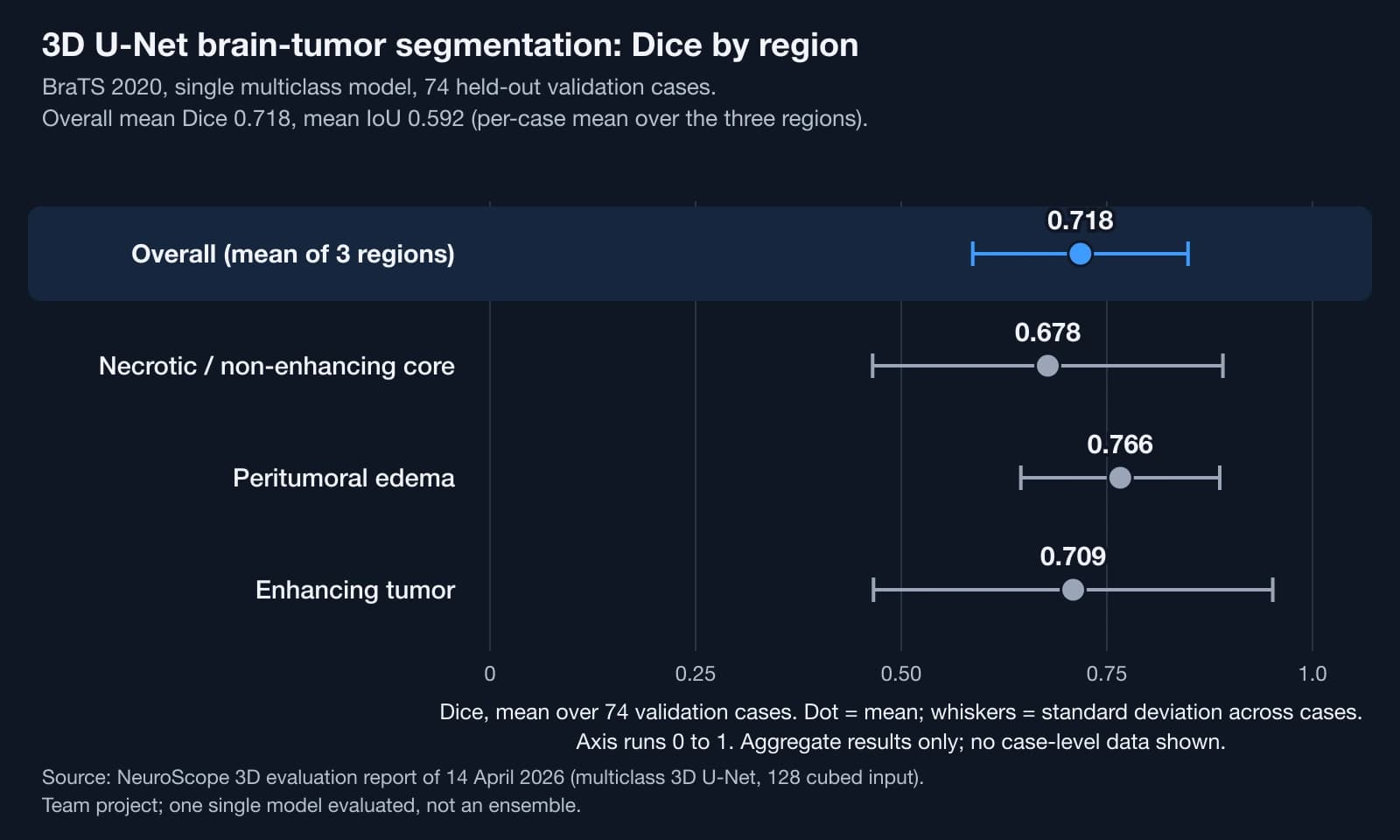
Mean Dice of one multiclass 3D U-Net on 74 held-out BraTS 2020 validation cases, per tumor sub-region and overall (macro Dice 0.7178, mean IoU 0.5918). Whiskers are the standard deviation across cases, not a confidence interval. Aggregate results only, from the 14 April 2026 evaluation report; the single model is shown, not an ensemble. Team project with Yash Jain, who is credited in the repository's source headers; my part was the training runs, HPC orchestration and evaluation.
Problem
Brain-tumor segmentation on BraTS-style MRI needs a training and evaluation setup that others can rerun, not only a good score. The project needed the model trained at scale on a shared GPU cluster, and the result recorded so that it could be audited later.
Approach
The model is a multimodal, four-channel, multiclass 3D U-Net of about 5.6 million parameters, trained on BraTS 2020 with a split of 294 training and 74 validation cases. Training ran on an NVIDIA H200 GPU through Slurm job templates on Northeastern's Explorer cluster, with mixed precision. Evaluation writes a report stamped with the git commit, the split fingerprint and the software environment.
How it was built
Team project with Yash Jain, who is credited in the repository's source headers: a multimodal 3D U-Net for BraTS 2020 with a FastAPI and Plotly viewer. My part was running it on Northeastern's Explorer cluster. I submitted the 150-epoch training as a five-fold SLURM job array on H200 GPUs, about 13.2 GPU-hours in total, then ran the evaluation that writes a report stamped with the git commit, split fingerprint and environment. On the 74 held-out validation cases, the single model scored macro Dice 0.7178 and IoU 0.5918. Limits: one model, one split; I leave out the repository's higher ensemble figure, which is not comparable.
Evidence and limitations
On the 74 held-out validation cases, the single model reached macro Dice 0.7178 and mean IoU 0.5918, defined as the per-case mean over the three tumor sub-regions. Dice was 0.678 for the necrotic and non-enhancing core, 0.766 for edema and 0.709 for enhancing tumor, with wide spread across cases.
Limits: one model, one validation split and standard deviation across cases rather than a confidence interval. The repository also quotes a higher ensemble score, but it is not comparable and its validation cases overlap the training data of other ensemble members, so I leave it out. This is research code, not a clinical tool.