Cybersecurity · Bitcoin
BitShield
A team-built Bitcoin security dashboard; I built the guardian engine and Cogcoin anchoring and co-built its rule-based quantum-exposure scanner.
- Context
- MIT Bitcoin Expo 2026, Team ACE · hackathon project
- Stack
- TypeScript, bitcoinjs-lib, Hono, Bun
How it works
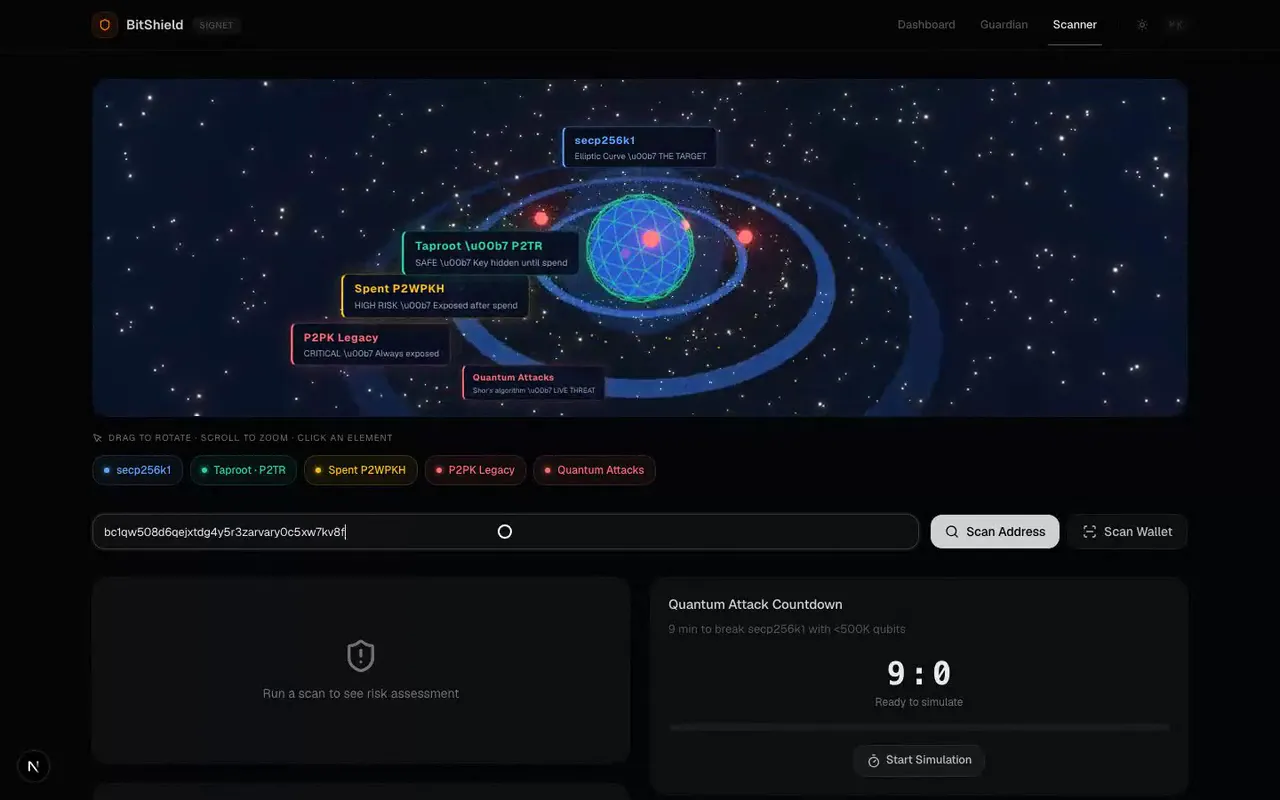 Recorded demo
Recorded run of BitShield's rule-based quantum-exposure scanner on public test addresses (no wallet, no API keys). The 3D view renders slowly on a software renderer, so typing looks slow.
MIT Bitcoin Expo 2026 Hackathon, Team ACE. The scanner was co-built with a teammate; my part was the Guardian and Cogcoin work.
Explore the risk view
The scanner page opens on a 3D quantum-risk visualizer that can be dragged to rotate.
Open a risk category
Clicking the Spent P2WPKH chip opens its detail panel.
Scan a public test address
A BIP-173 test-vector address is scanned; the rule-based scanner returns LOW risk for a P2WPKH address.
Scan a Taproot test address
A BIP-350 test-vector address is scanned and returns MEDIUM risk for a P2TR address.
Read the network panel
The network-vulnerability panel and the attack countdown sit below the scan results.
Highlights
- Co-built scanner: classifies six Bitcoin address types (P2PK through P2WSH) by quantum exposure
- Address typing via bitcoinjs-lib and spent-status lookups via mempool.space Signet
- Generates a migration plan for at-risk addresses
How it was built
At the MIT Bitcoin Expo hackathon our team built a Bitcoin security dashboard. I wrote the guardian engine, which sends a user's request to Claude and accepts only strict JSON naming one of eight wallet intents, with whitelist validation and a safe "unknown" default. I also wrote the Cogcoin integration that anchors guardian actions on chain. With a teammate, I co-built the quantum-exposure scanner, which types Bitcoin addresses with bitcoinjs-lib and looks up spent status on the Signet network. Teammates built the wallet and Lightning features, dashboard and deployment. Limits: rule-based scanner, not a model; not an autonomous agent.